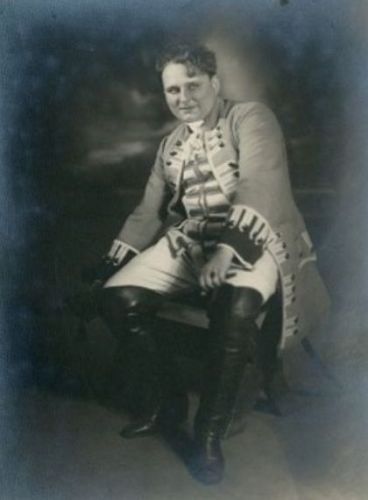
Her real name was Hermine
von Flick. She studied singing under Ms. Aurelie Jäger-Wilczek in Vienna and
made her debut in 1898 at the Hoftheater in Wiesbaden as Ännchen in ‘’Freischütz’’.
She remained there until 1900 and in the 1900-1901 season sang at the Vienna
Court Opera. Since 1901 until her retirement (1926) she was a member of the
Munich Court Opera. In 1903 she appeared in the
Munich premiere of the opera ‘’Le Donne curiose’’ by Ermanno Wolf-Ferrari (in the
Residenztheater) as Colombine, in 1906 she sang here (again at the Residenztheater)
in the premiere of the opera ‘’I quattro rusteghi’’ by E. Wolf-Ferrari, in 1912
at the Court Opera in the world premiere of the opera ‘’Franfreluche’’ by Wilhelm
Mauke. In 1910 she created G. Puccini's Butterfly for Munich, in 1911 the
Octavian in R. Strauss’s ‘’Rosenkavalier’’ and J. Massenet's Manon, in 1913 the
Zerbinetta in ‘’Ariadne auf Naxos’’ by R. Strauss. She appeared as a guest in
1905 and 1914 at the Berlin Court Opera, in 1910 at the Court Opera in Dresden,
in the 1908-1911 seasons several times at the Vienna Court Opera, in the 1905-1915 seasons at the Court Theater
of Stuttgart, in 1907 at the Deutsches Theater in Prague, in 1908 at the Vienna
Volksoper, from 1906 to 1915 at the Frankfurt a.M. Opera House, also at the
opera houses of Cologne and Leipzig, at the Stadttheater in Bremen, in 1906 and
1907 at the Riga Opera House, in 1912 at the Théâtre de la Monnaie in Brussels
and in 1921 at the Stadttheater in Basel. Guest performances also brought her
great successes in Russia; she sang in St. Petersburg among others as a partner
of Mattia Battistini. In 1912 she made guest appearances at the Municipal
Theater of Zurich as Susanna in ‘’Figaros Hochzeit’’, Violetta in ‘’Traviata’’ and as Frau Fluth in ‘’Lustigen
Weibern von Windsor’’. At the Covent Garden Opera (1907) she appeared in ‘’Bartered
bride’’ by B. Smetana's and ‘’Die Meistersinger von Nürnberg’’ of R. Wagner. In
1913 she was heard at His Majesty's Theater of London in the English premiere
of the Richard Strauss’s opera ‘’Ariadne auf Naxos’’. The same season, again at
the Covent Garden Opera she sang the role of Octavian in R. Strauss’s ‘’Rosenkavalier’’.
She remained active until 1926 at the Munich Opera (1924-1926 as a guest). From
1924 to 1930 she was a teacher at the Hoch Conservatory in Frankfurt a.M., then
in Munich. Her daughter Elly Bosetti appeared in the 1930’s as soprano (debut
in 1935 at the Municipal Theater of Bamberg as Lola in ‘’Cavalleria Rusticana’’).
HELLO AND WELCOME TO MY SITE. MY NAME IS ASHOT ARAKELYAN. I’M A RECORD COLLECTOR. GREATEST OPERA SINGERS IS THE MOST COMPREHENSIVE AND THE ONLY WEBSITE ENCYCLOPEDIA ON WORLD WIDE WEB. IT PROVIDES BIOGRAPHIES, CHRONOLOGICAL INFORMATION, PHOTOS, LABELS AND SOUND SAMPLES TO OVER 2500 OPERA SINGERS. ADDITIONS AND CORRECTIONS ARE WELCOME AND WILL BE ACKNOWLEDGED.
Greatest Opera Singers
Friday, November 30, 2018
Monday, November 19, 2018
Elisabeth Rethberg (Soprano) (Schwarzenberg, Germany 22 September 1894 – Yorktown Heights, New York 6 June 1976)
Her real name was
Lisbeth Sättler. Already in her childhood, she showed an amazing musical talent
and performed Schubert songs at the age of seven. First she studied piano
(1912-1913), then singing at the Conservatory of Dresden, and finally with the
Dresdner educator Otto Watrin. She made her debut at the Dresdner Hofoper in
1915 as Arsena in "Zigeunerbaron" and had her first great success
there as Agathe in "Freischütz". In 1919 she sang the role of Empress
in the Dresden premiere of "Frau
ohne Schatten" by R. Strauss. On 11. 12. 1917 she appeared in Dresden in
the premiere of Hans Pfitzner's "Christelflein", on 23. 2. 1920 in
Hugo Kaun's "Der Fremde". Then
she performed at the Hofopern in Vienna and also in Berlin. She was very
successful at the Leipzig Gewandhaus concerts. She remained in Dresden until
1922 and then joined to the Metropolitan Opera in New York, where she had
brilliant successes from 1922 to 1942. Her debut role in New York was Aida.
Here she also sang in 1928 in the premiere of Respighi's "Campana sommersa". Arturo Toscanini called her voice the most
beautiful soprano he has ever heard. In the 1928-1940 seasons she performed
again and again at the San Francisco Opera,
from 1934 to 1941 at the Chicago Opera; she also appeared at the Ravinia
Festival near Chicago. In 1923 and 1928 she sang at the Havana Opera, in 1925 and from 1934 to 1939 at the Covent
Garden Opera in London, in 1929 at La Scala in Milan (as Aida under Toscanini)
and in 1934 at the Teatro dell'Opera di Roma. In 1936 she appeared with great
success in R. Strauss’s
"Rosenkavalier" at the Covent Garden Opera in London. She was
also heard in her native country: on June 6, 1928 she appeared in the title
role at the Staatsoper in Dresden in the world premiere of R. Strauss’s opera
"Die Ägyptische Helena". At the Salzburg Festival she sang the role
of Konstanze in Mozart’s "Entführung aus dem Serail" (1922), in 1933
she performed as Leonore in "Fidelio" and in 1937 as Donna Anna in
"Don Giovanni", in 1933 she sang the soprano solo in the G. Verdi’s
‘’Requiem’’. Concert tours have taken her through North America, Canada,
Australia and Europe. Her first husband was the merchant Albert Doman. In 1957
she married the baritone George Cehanovsky (1892-1986). In 1942 she retired from
the stage. In 1944 she gave a final concert at the New York Town Hall. She
continued to live in New York. Her repertoire included Aida, Donna Anna,
Desdemona, Leonora in "Trovatore", Butterfly, Tosca, Agathe in
"Freischütz", Maddalena in "Andrea Chénier", Sieglinde,
Elsa, Elisabeth in "Tannhäuser" and Sieglinde in "Walküre".
Sunday, November 11, 2018
Hans Duhan (Baritone) (Vienna, Austria January 27, 1890 - Vienna, Austria March 6, 1971)
He studied at the
Vienna Academy of Music and made his debut in 1910 at the Municipal Theater of
Opava, where he performed until 1913, in the 1913-1914 season he was engaged by
the Municipal Theater of Teplice-Schönau. In 1914 he became a member of the
Vienna Court Opera. He remained a principal baritone of this opera house until
the end of his stage career (1940). In Vienna, Hans Duhan gained great
popularity, as well as at the Salzburg Festival, where he repeatedly appeared
in Mozart roles. In 1922 he sang the part of Don Giovanni at the Salzburg
Festival. In 1922 and 1927 he appeared there as Count in ‘’Figaros Hochzeit’’,
in 1928 as Papageno in ‘’Zauberflöte’’. Until 1937 he gave recitals there,
which were highly appreciated by festival audiences. On 4. 10. 1916 he appeared
in Vienna in the premiere of the revision of the Richard Strauss’s opera
‘’Ariadne auf Naxos’’, in 1934 in the world premiere of F. Lehár's operetta
‘’Giuditta’’ (20. 1. 1934). He guested in Amsterdam in 1922 (and again in 1924
in a guest performance by the ensemble of the Vienna State Opera with ‘’Ariadne
auf Naxos’’). His repertoire included King Solomon in ‘’Königin von Saba’’,
Amfortas in ‘’Parsifal’’, Frank in ‘’Toten Stadt’’, Scarpia in ‘’Tosca’’ and
Escamillo in ‘’Carmen’’. In 1930 he created the song cycle ‘’Reisetagebuch aus
den österreichischen Alpen’’ by Ernst Krenek. In 1938 he sang in Vienna in the
world premiere of the oratorio ‘’Das Buch mit sieben Siegeln’’ by Franz
Schmidt. Since 1932 he was appointed as a professor of the Vienna Music
Academy. He also worked as director and conductor at the Vienna State Opera. He
also composed several vocal works.
Marise Beaujon (Soprano) (Lyon, France 12 October 1890 – 16 August 1968 Paris, France)
She was discovered at
an amateur singing competition by the director of the Lyon Opera Gaston
Beyle.She made her debut at this opera house in 1919 as Micaela in ‘’Carmen’’.
For ten years she sang at provincial French theaters before she was engaged by
the Grand Opéra in Paris in 1921. Here she made her debut as Mathilde in
‘’Guillaume Tell’’ by G. Rossini. Until 1930 she remained a celebrated member
of the Grand Opéra, where in 1928 she sang the title role in the premiere of G.
Puccini's ‘’Turandot’’. In 1926 she performed in Madrid, Barcelona and Monte
Carlo, in 1928 in Brussels, in 1929 in Cairo. In 1928 she sang the part of
Marguerite in ’’Faust’’ at the Covent Garden Opera in London. In 1927 she
appeared at the Opéra de Monte-Carlo as Marshal in ‘’Rosenkavalier’’, Rezia in
‘’Oberon’’, Marina in ‘’Boris Godunov’’ and as Thaïs in J. Massenet’s
‘’Thaïs’’. She also performed at the opera houses of Liège and Antwerp. In 1930
she joined to the Opéra-Comique in Paris.Here she made her debut as Tosca. in
1932 she appeared at the Théâtre Mogador in Paris in J. Offenbach’s operetta
‘’Orphée aux enfers’’, but soon she retired from the stage for health reasons,
after she had again achieved one of her great successes at the Opéra-Comique in
the title role of G. Charpentier’s ‘’Louise’’.
Xenia Belmas (Soprano) (Tschernigow, Ukraine 23 January 1890 – Durban, South Africa 2 February 1981)
She trained at the
Conservatory of Kiev under Päts and made her debut in 1913 at the Odessa Opera,
where she had her first successes as Wagnerian singer and as Tatiana in
Tchaikovsky's ‘’Eugene Onegin’’ and remained the leading singer of this opera
house until 1921. In 1921 she left with her husband, the conductor Alexander
Kitschin, Russia and settled in Wiesbaden. After further studies in Italy, she
gave a series of brilliant concerts in Paris (1925) and until 1927 guested at
the Grand Opéra in Paris, especially as Aida. In 1928 she was celebrated at
concerts in Berlin, where her recordings were made. In 1929 she toured with an
Italian opera troupe Australia. In 1931 she gave a concerts in Monte Carlo. In
1932 she made guest appearances in the Baltic States. Opposite her husband she
made guest appearances through South
Africa (1934), then she taught singing in Durban.
Thursday, October 25, 2018
Hipolito Lazaro (Tenor) (Barcelona, Spain 1887 - Barcelona, Spain 1974)
His voice was
discovered during military service. He made his debut at the Teatro Novedades
in Barcelona in 1910 without special study of singing. After studies with
Ernesto Colli in Milan, he sang in
London and Manchester, England in 1913 under the name Antonio Manuele. He first
created a sensation at La Scala when he sang in the world premiere of
Mascagni's Parasina (1913). In 1918, Lazaro came to the Metropolitan opera,
where he sang for three seasons, performing 8 roles in 34 performances. He
appeared as a guest at all of the world's great opera houses, and also created
roles in Mascagni's Piccolo Marat at the Teatro Costanzi in Rome in 1921, and
in Giordano's Cena delle Beffe at La Scala in 1924. During the Spanish Civil
War he was for a short time the director of the Teatro Liceo in Barcelona. He
gave a farewell concert in New York in 1940, but appeared again at the Teatro
Liceo in 1944 and at the Havana Opera in 1950. He had a wide-ranging, timbred,
considerably vibrant, extended, bold, resilient even if slightly guttural voice
with a brilliant metallic shine, and a passionate approach to singing.
Chronology of some
appearances
1910 Valencia Teatro
Prencesa Favorita (Fernando)
1911 Milano Teatro Dal Verme Boheme (Rodolfo)
1912 Il Cairo Teatro Abbas Boheme (Rodolfo)
1914 Roma Teatro Costanzi Boheme (Rodolfo)
1914 Roma Teatro Costanzi Favorita (Fernando)
1914 Montevideo Teatro Solis Boheme (Rodolfo)
1914 Montevideo Teatro Solis Favorita (Fernando)
1914 Buenos
Aires Teatro Coliseo Fanciulla del West
(Dick Johnson)
1914 Buenos
Aires Teatro Coliseo Favorita (Fernando)
1914 Rio de Janeiro
Teatro Municipal Fanciulla del West (Dick Johnson)
1914 Rio de Janeiro
Teatro Municipal Favorita (Fernando)
1914 Barcelona Teatro
Liceo Favorita (Fernando)
1915 Buenos
Aires Teatro Colon Boheme (Rodolfo)
1915 Buenos
Aires Teatro Colon Fanciulla del West
(Dick Johnson)
1915 Rio de
Janeiro Teatro Municipal Boheme
(Rodolfo)
1915 Porto Alegre Teatro San Pedro Boheme (Rodolfo)
1915 San PaoloTeatro
Municipal Boheme (Rodolfo)
1915 Montevideo
Teatro Solis Carmen (Don Jose)
1915 Roma Teatro
Costanzi Fanciulla del West (Dick Johnson)
1916 Havana Teatro Nacional Boheme (Rodolfo)
1916 Havana Teatro Nacional Fanciulla del West (Dick
Johnson
1917 Mexico City Teatro Arbeu Barbiere di Siviglia (Almaviva)
1918 Mexico City Plaza de Toros Favorita (Fernando)
1920 Lisbon Teatro
San Carlo Boheme (Rodolfo)
1920 Havana Teatro Nacional Boheme Fanciulla del West
(Dick Johnson)
1920 Havana Teatro Nacional Favorita (Fernando)
1920 Mexico City Teatro Arbeu Fanciulla del West (Dick
Johnson)
1920 Mexico City Teatro Arbeu Favorita (Fernando)
1927 Havana Teatro
Nacional Carmen (Don Jose)
1928 Firenze Politeama
Fiorentino Carmen (Don Jose)
Monday, October 22, 2018
Mária Basilides (Contralto) (Ilosvár, Hungary November 11, 1886 – Budapest, Hungary September 26, 1946)
She received her
education at the Music Academy of Budapest. In 1911 she made her stage debut at
the Volksoper in Budapest; she made her debut in ‘’Quo vadis?’’ by Nouguès. In
1915 she was engaged by the National Opera of Budapest, where she was so
popular, that in 1934 she became a lifelong member of this House. Here, on 24.
4. 1932, she sang in the premiere of ‘’Székely fono’’ by Zoltán Kodály. She
made successful guest appearances at the Berlin State Opera, at the state
operas in Dresden and Munich, at the Opera in Prague and at the Antwerp Opera
House. She also toured in Brussels (1929), The Hague (1929) and in Bucharest,
gave very successful concerts in Berlin (1927-1929) and London (1930). One of
her last stage performances was in Budapest, where she sang the part of an old countess
in ‘’Pique Dame’’ by Tchaikovsky (1945). She was considered an outstanding
concert singer. In 1937 she sang in a cathedral concert at the Salzburg
Festival. She was one of the first singers to support Hungarian folk music,
rediscovered by Bela Bartók and Zoltan Kodály, and had a great influence on the
entire musical life of her time in Hungary. She made a few records for
Parlophon and HMV.
Marion Talley (Soprano) (Nevada, Missouri, USA December 20, 1906 – Beverly Hills, Los Angeles, California, USA January 3, 1983)
She was a musical
prodigy and she began singing at the age of five. She was only 15, when settled
in Kansas City. She showed an amazing talent in piano and violin playing. Then
she studied with Frank La Forge in New York, where she also gave her first
concerts. After additional education in Europe she made her debut in 1926 -
only 19 years old - at the Metropolitan Opera in New York as Gilda in
"Rigoletto" (opposite Giacomo Lauri-Volpi and Giuseppe de Luca). She
had a sensational success. Both the critics and the audience enthusiastically
celebrated them. A special train was used from her hometown Kansas City to New
York. The following three seasons she remained a member of the Metropolitan
Opera. There she sang in 1926 in the premiere of "Le Rossignol" by I.
Stravinsky. At the Metropolitan Opera her repertoire included the Queen of the Night in
"Zauberflöte", Lucia di Lammermoor, the Olympia in ‘’Les contes
d'Hoffmann’’, the Philine in "Mignon" and the Queen of Shemakan in N.
Rimsky-Korsakov ‘s ‘’The Golden Cockerel’’. She appeared at the Metropolitan
Opera until 1929. A triumphant North American tour in 1928 marked the peak of
her career, which ended as quickly as it had begun. In 1929 she retired to her
farm and did not appear again until 1933. In 1933 she appeared as Gilda at the
Chicago Opera, but without success. In 1934 she tried Vitaphone sound film,
later she became a radio singer. In 1939, encouraged by successes on American
radio, she reappeared at the concert hall, but remained without any major
successes, whereupon she withdrew from musical life. Then she lived in
Hollywood. She was briefly married the pianist and accompanist Michael
Raucheisen (1889-1983).
Carl Jöken (Tenor) (Krefeld, Germany 3. November 1893 - Hamburg, Germany 7. April 1971)
First he studied
chemistry and from 1914 to 1918 as a soldier took in the First World War.
Without proper vocal studies he made his debut in 1918 at the Stadttheater of
Krefeld as Manrico in "Trovatore". In the 1920-1923 seasons he was a
soloist of the Stadttheater in Freiburg i. Br., Since 1923 he appeared at the
Berlin Staatsoper. Here he sang the parts of Pinkerton in "Madame
Butterfly" and Eisenstein in "Fledermaus" and also participated
in the Berlin premiere of L.
Janáček’s "Jenufa" (1924).
Although he had in his repertoire roles such as Tamino in
"Zauberflöte", Rodolfo in "La Bohème" and Cavaradossi in
"Tosca", but he gladly took over also buffo roles like Pedrillo in
"Entführung aus dem Serail", Don Curzio and Basilio in "Figaros
Hochzeit", David in "Meistersingern"and Mime in the Ring Cycle.
In 1928 he appeared at the Berlin State Opera in the world premiere of Franz
Schreker's "Der singende Teufel". Until 1934 he remained a member of
the Berlin State Opera. During this time he also appeared at the Berlin Kroll
Opera, u.a. 1927 in the world premiere of "Royal Palace" by Kurt
Weill. He later turned mainly to the operetta, after he had tremendous
successes in 1930 at the Metropol Theater in Berlin in Millacker's
"Bettelstudent" and in the premiere of "Das Veilchen vom
Montmartre" by Kalmán. In 1930 he
sang in Amsterdam in "Fledermaus" under Bruno Walter, the same
performance was repeated at the Covent Garden Opera in London. In the 1931-1932
season he worked at the Teatro Colon in Buenos Aires, especially in buffo
repertoire, and worked there in 1931 in the premiere of Stravinsky's
"Oedipus Rex". Since 1933 he had a huge successes at the Berlin
Theater of the West in operettas such as "Die lockende Flamme" by
Künnecke (world premiere on 27. 12. 1933), "Der Page dsr Königs"
(1933) and "Der goldene Pierrot"
by Walter W.Goetze. The career of the singer took a long time, even in
1956 he sang at the Hamburg Operetta Theater. Married the actress and cabaret
artist Käthe König. With his second wife Edith Schollwer, who performed in
operettas, he made a few records on Electrola.
Germaine Cernay (Mezzo-Soprano) (28 April 1900, Le Havre - 19 September 1943, Paris)
Her real name was Germaine Pointu. At first, she wanted to become a
pianist, but then she studied voice at the National Conservatory in Paris with
the teachers Albers und Engel. She made her debut in 1925 at the Paris Grand
Opéra as Euryclée in ‘’Pénélope’’ by Gabriel Fauré. In 1927 she came to the
Opéra-Comique in Paris, where she first sang smaller roles, then roles like
Charlotte in ‘’Werther’’, Carmen, Mignon, and Geneviève in ‘’Pelléas et
Mélisande’’. In 1930 at that house she took part in the world premiere of the
opera ‘’Le Sicilien’’ by Omer Letorey. She had important successes at the
Théâtre de la Monnaie in Brussels and on French provincial stages. She gave
guest performances in North Africa, in Switzerland, in England, Ireland and
Italy, where she appeared in the 1939 Florence May Festival as Florenz in
Ravel's ‘’L'Enfant et les sortilèges’’. In a broadcast of French Radio she even
undertook the soprano role in ‘’Pelléas et Mélisande’’. She was regarded as one
of the leading French concert altos of her generation, above all as a great
Bach interpreter. She was on the point of entering a convent when she suddenly
died. In addition to her exquisitely cultured (above all in the high register)
voice, her ingenious art of delivery as well as her mastery of phrasing were
treasured. She represented a voice type which the French designate
'Galli-Marié' (after the great prima donna, Célestine Galli-Marié).
Monday, October 15, 2018
Max Kuttner (Tenor) (Baden, Austria 24 February 1883 - Straubing, Germany 17 October 1953)
After a technical education Kuttner worked
first as a designer in Frankfurt am Main, but there he also trained as a
singer. In 1905 he made his debut at the Lortzing Theater in Berlin. After
training his voice, he began his stage career in 1904 at the Court Theater of
Weimar and sang since 1906 at the Lortzing Theater in Berlin. He specialized in
the tenor buffo roles in which he proved to be a superior actor. He sang
Jacquino in "Fidelio", Pedrillo in the "Entführung aus dem
Serail", Monostatos in the "Zauberflöte". His career took place
mainly at various Berlin theaters. He moved to the field of operetta in the
twenties and had great success as an operetta tenor in Berlin. He became known
as a radio and record singer. In 1933 he left Germany as a Jew and finally came
to China. There he appeared in operettas in Shanghai (1940-1941). After the
Second World War, he returned to Germany, where he died in 1953 in Straubing in
Bavaria. Married the opera singer Nelly Bondy, who sang in Weimar and at the
Komische Oper in Berlin.
Georgy Nelepp (Tenor) (Bobruika, Ukraine, 20 April 1904 - Moscow, 18 June 1957)
He studied at the Leningrad Conservatory and made his debut, as
Lensky, with the Kirov in 1930, remaining with the company until 1944. In that
year he moved to the Bol'shoy, where he had his most significant success.
Nelepp possessed a lyric-dramatic tenor capable of an amazing range and
intensity of expression, making him an ideal exponent of such roles as
Florestan, Gustavus III, Manrico, Radames, Don José, Sobinin (‘’A Life for the
Tsar’’), Dmitry (‘’Boris Godunov’’), Golitsin (‘’Khovanshchina’’), Yury (‘’The
Enchantress’’), Hermann, Andrey (‘’Mazepa’’) and Sadko, several of which he
recorded. He sang in approximately 20 complete opera sets, among which his
agonized portrayal of the obsessive Hermann in the Melodiya recording of The
Queen of Spades is an unrivalled achievement.
Elisabeth Böhm Van Endert (Soprano) (Neuss 31. 12. 1876 † Zürich 27. 02. 1956)
She began her singing studies with Wally Schauseil in Düsseldorf and continued with Richard Müller in Dresden. First she appeared in concerts and oratorio parts. At the instigation of the great conductor Ernst von Schuch, who appeared in Dresden, she turned to the stage career. She made her stage debut in 1907 at the Hofoper in Dresden (as Marguerite in ‘’Faust’’), where she remained until 1910. From 1910 to 1913 she was engaged by the Court Opera in Berlin (where she had already performed in 1909), from 1913 to 1921 she was a soloist of the Deutsche Oper in Berlin-Charlottenburg, in the 1921-1923 seasons she sang at the Staatsoper in Berlin. Here she appeared as Pamina in ‘’Zauberflöte’’, Micaela in ‘’Carmen’’, Freia in '’’Rheingold’’, Eva in ‘’Meistersingern’’, Marguerite in ‘’Faust’’, Rosalinde in ‘’Fledermaus’’ and Octavian in ‘’Rosenkavalier’’. Guest performances and tours led the artist to England, Belgium, Holland and Switzerland. In the 1920s she undertook two major North American tours. During her Dresden engagement she appeared on 25. 1. 1909 in the world premiere of the opera ‘’Elektra’’ by R. Strauss. After 1923 she gave only single stage performances, but was mainly to be heard as a concert soloist, such as 1926 on a Holland tour and, also in 1926, in London. In her second marriage she was married the director of the Electrola record company, Leo Curth. After her retirement she lived in Berlin and taught singing, but in 1935she emigrated to North America.
Chronology of some appearances
1907-1910 Dresden Hofoper
1910-1913 Berlin Court Opera
1913-1921 Berlin-Charlottenburg Deutsche Oper
1921-1923 Berlin Staatsoper
Tuesday, October 9, 2018
Mafalda Salvatini (Soprano) (Baiae, Italy 17 October 1886 - Lugano, Switzerland 13 June 1971)
Santuzza
Her father was an officer of the Neapolitan army and she was already
orphaned when she was four. She studied singing under Jean de Reszke and
Pauline Viardot-Garcia in Paris. In 1908, during a guest performance at the
Berlin Court Opera, she caused a sensation as Aida and from 1911 to 1914 she
was a member of this opera house. In 1912 she performed at the Hofoper in
Munich, in 1913 at the Grand Opéra in Paris, where she performed as Valentine
in "Les Huguenots" of G. Meyerbeer. In the 1914-1923 seasons she was
engaged by the German Opera House in Berlin-Charlottenburg. Although in the
1924-1926 seasons she again appeared at the State Opera (the former Hofoper) in
Berlin, but came back in 1926 to the German Opera House, where she continued
her career until 1932. In 1926 she created for Berlin the title role in G.
Puccini’s opera "Turandot", where she scored one of her greatest
successes. In 1927 she was a guest at the Dresden State Opera, in 1922 and 1928
at the Vienna State Opera, in 1928 at the Riga Opera House. She also made guest
appearances in Holland and Belgium, but never in her native Italy. At the
beginning of the thirties she married the Lithuanian Ambassador in Germany.
After her retirement she lived in the Swiss canton of Ticino.
Sunday, September 9, 2018
Willis James Flanagan (Tenor) (Holyoke, Massachusetts 1882 - ?)
He began as a baritone studying with Murrie 1920's in Italy, France and Germany, making extensive tours singing. He then studied in London to become a tenor finishing his studies with Mr Addison Price the composer and vocal teacher. He has sung in London Palladium, Queens Theater and many other concerts hall in England with the best of the stars, one of them being Nordica. In Italy he appeared as Paul Castello.
I wish to thank his grandchild Michelle Dennis for providing me information and photos
Saturday, August 25, 2018
Laczó István (Tenor) (September 16, 1904, Szombathely, Hungary - September 27, 1965 Budapest, Hungary)
He initially studied
architecture and then trained as singer mostly in Italy. In 1935 he made his
debut at the National Opera in Budapest and remained a member of this opera
house until the end of his career. Before the World War II, he guested at the
Grand Opéra in Paris, also in Turin and Rio de Janeiro. His repertoire included
Otello, the Manrico in ‘’Trovatore’’, Radames in ‘’Aida’’, Kalaf in
‘’Turandot’’, Arnoldo in ‘’Guglielmo Tell’’, Turiddu in "Cavalleria
Rusticana’’ and Canio in "Pagliacci". In 1963 he was appointed
Honored Artist of the Hungarian People's Republic.
Chronology of some
appearances
1935-1950’s
Budapest National Opera
Lajos Laurisin (Tenor) (March 26, 1897, Kalocsa, Hungary - January 10, 1977, New York City, New York, United States)
He received his
education in Budapest under Szidi Rákosi and Béla Szabados. From 1926 to 1944
he was a member of the Budapest National Opera. At this opera house he sang a
varied repertoire and his roles included Duke in "Rigoletto", Canio
in "Pagliacci", Cavaradossi in "Tosca", Kalaf in
"Turandot" and Rodolfo in "La Bohème". In addition, he was
a famous operetta singer. His brother was the composer Miklós Laurinsin
(1893-1949).
Chronology of some
appearances
1926-1944 Budapest
National Opera
Endre Rösler (Tenor) (November 27, 1904, Budapest, Hungary - December 13, 1963, Budapest, Hungary)
Almaviva
First he studied with
Géza Laszló in Budapest, then under Giuseppe de Luca in Milan and Edoardo
Garbin in Brescia. In 1927 he made his debut at the National Opera in Budapest
as Alfredo in "La Traviata". On 24. 4. 1932 he sang at the Budapest Opera
in the world premiere of Zoltán Kodály's "Die Spinnstube". He made
successful guest appearances in Vienna, Milano, Florence, Leipzig and Munich.
At the Budapest Opera his repertoire included the title part in Händel’s
"Xerxes", Count Almaviva in ‘’Barbiere di Siviglia’’, Belmonte in
"Entführung aus dem Serail", Don Ottavio in "Don Giovanni",
Ferrando in "Così fan tutte", Lenski in "Eugene Onegin",
Florestan in "Fidelio", Max in "Freischütz", Erik in "Fliegenden
Holländer", Loge in "Rheingold" and Schuiskij in "Boris
Godunov". Since 1953 he taught singing at the Franz Liszt Academy of Music
Budapest; one of his students was Eva Marton.
Chronology of some appearances
1927 Budapest National Opera Traviata
(Alfredo)
1932 Budapest National
Opera Die Spinnstube (-)
Gabor Carelli (Tenor) (Budapest, Hungary 1915 – New York 22 January 1999)
He studied law and
singing at the Franz Liszt Conservatory in Budapest. After two years of further
education in Italy (also under Beniamino Gigli), he made his debut in Florence
and then sang at the Italian opera houses. Then he went to North America, where
from 1951 to 1974 he was a member
of the Metropolitan Opera in New
York (almost 26 years) and sang mainly as tenor buffo. Here he made his debut
as Don Curzio in ‘’Nozze di Figaro'’ (which he sang there 111 times) and was
heard in 56 roles and in over a thousand performances there. His repertoire
included Arturo in ‘’Lucia di
Lammermoor’’, Abbé in ‘’Adriana
Lecouivreur’’, Borsa in ‘’Rigoletto’’ (which he sang 118 times), Gaston in ‘’La
Traviata’’, Trin in ‘’La Fanciulla del West’’, Elemer in ‘’Arabella’ by R.
Strauss, Count Almaviva in ‘’Il Barbiere di Siviglia’’, Ernesto in ‘’Don
Pasquale’’, Rodolfo in ‘’La Bohème’’, Pinkerton in ‘’Madama Butterfly’’, Duka
in ‘’Rigoletto’’, Cavaradossi in ‘’Tosca’’,
Alfredo in ‘’La Trvaiata’’,
Captain in ‘’Wozzeck’’and as Tonio in ‘’La Fille du régiment’’. During two
seasons he also worked in Israel. Since 1964 he taught singing at the Manhattan
School of Music New York.
Chronology of appearances
1951-1974 New York Metropolitan Opera
Maria Russo (Mezzo-Soprano)
She was to young to
sing in Guy Golterman’s grand operas At
MUNY and Kiel, but St Louis
Mezzo-Soprano Maria’Russo’s career was ‘moved along’ by the impressario.
Golterman arranged auditions with the Met’s Fausto Cleve. He also contacted
Fortuno Gallo on her behalf. Maria persisted in New York. She found her role
‘Carmen’: First with the Charles Wagner Opera Company 1952 tour. This was
followed by a 10-weeks tour of South America with the South America Opera Company.others in the company
were Jan Pierce, Robert Weede and Herbs Nelli.
Her concert debut was with the St Louis Symphony Orchestra in 1949. In
New York she was coached by several of the Met’s conductors including Caesar
Sodero. Dramatic lessons by the Met’s Desire Defrere. The girl from the St Louis
‘Hill’ neighborhood did well. She never forgot Guy Golterman. Maria Russo never
came back to St Louis. I believe she stayed in New York.
By Ed
Golterman
Subscribe to:
Posts (Atom)