Greatest Opera Singers

Greatest Opera Singers

Tuesday, December 3, 2013

Luigi Piazza (Baritone) (Bologna 1884 - ?1967)


                                                               Rigoletto

He studied at the Conservatory of Bologna under the pedagogue Alberoni and probably made his debut in 1908 at Teatro Principe Amedeo of Sanremo in ‘’Traviata’’. In 1920 he appeared at the Teatro Rossini of Lugo in the world premiere of the ‘’L'Aviatore Dro’’ of  Balilla Pratella. He retired from the stage in 1935.

Chronology of some appearances

1908 Sanremo Teatro PrincipeAmedeo Traviata (Germont)
1912 Firenze Teatro Verdi Puritani (Riccardo)
1914 Bologna  Teatro Verdi Puritani (Riccardo)
1917 Bologna  Teatro Duse Rigoletto (Rigoletto)
1919 Venezia   Teatro Rossini Cavalleria Rusticana (Alfio)
1921 Cesena Teatro Comunale Boheme (Marcello)
1923 Malta Teatro Reale Andrea Chenier (Gerard)
1925 Pisa  Teatro Verdi Madama Butterfly (Sharpless)
1927 Lisbona Coliseo Recrejos Barbiere di Siviglia (Figaro)
1929 Bari Teatro Petruzzelli  Traviata (Germont)
1931 Ferrara Teatro Apollo Puritani (Riccardo)
1933 Milano Teatro Lirico Barbiere di Siviglia (Figaro)
1934 Pola  Teatro Ciscutti Manon Lescaut (Lescaut)


RECORDING FOR SALE


HMV, Milano  1927
Complete Rigoletto (Verdi) with Tino Folgar, Lina Pagliughi, Salvatore Baccaloni and Linda Brambilla

Private Record
Tannhauser (Wagner): O tu bell'astro


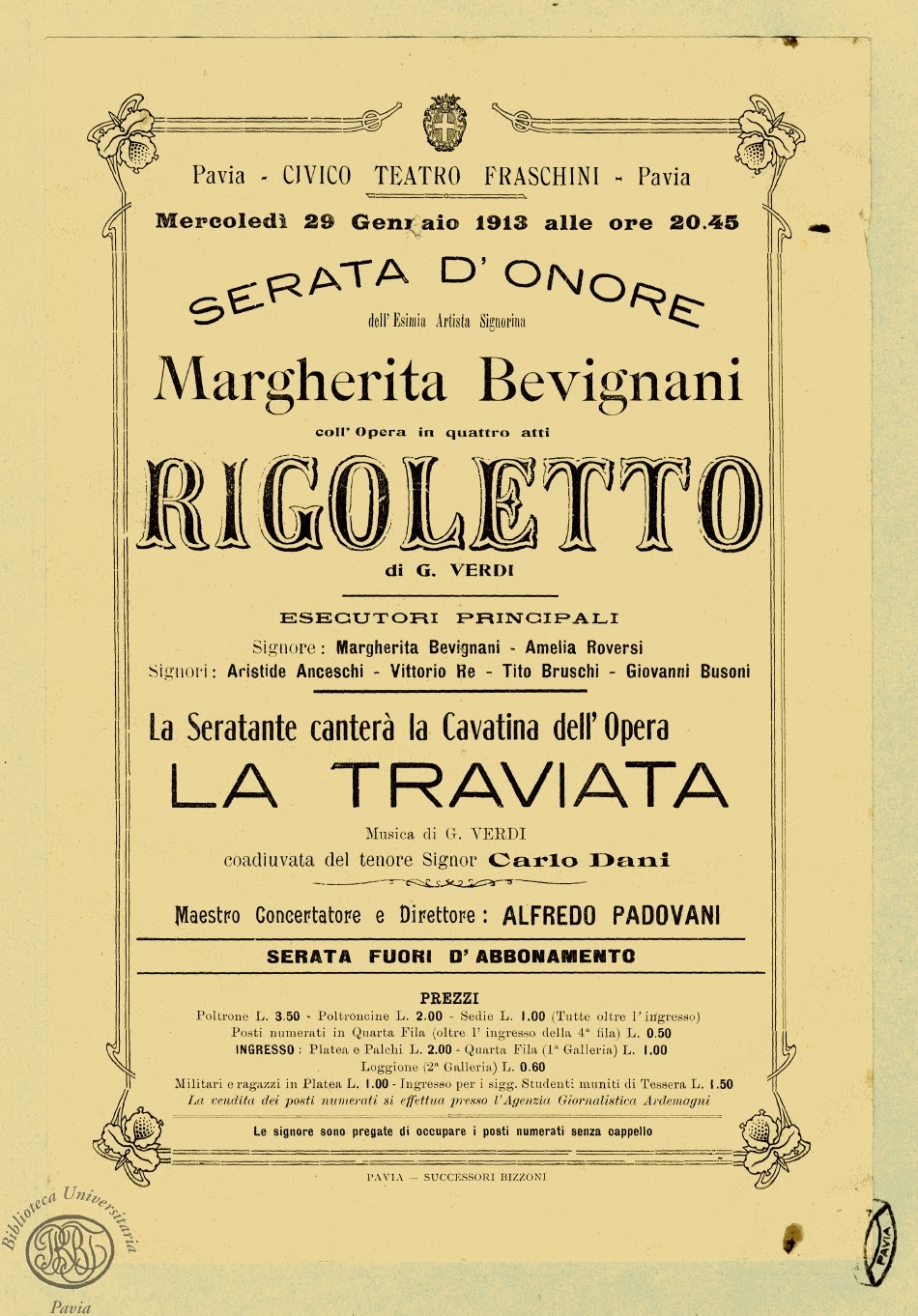
Margherita Bevignani (Soprano) (?1887 - Milano 1921)


She studied with Perilli and made her debut in 1909 at the Teatro Politeama Garibaldi of Trevisoas Micaela in ‘’Carmen’’. During the next years she appeared with success in Italian provincial stages, thus among other things in 1911 at the Teatro Donizetti  in Bergamoas Regina in ‘’Ugonotti’’ of Meyerbeer. In 1914 she made guest appearance in Holland and had there a big success in ‘’Traviata’’. When Italy entered into the First World War, she could leave Hollandonly by ship. The ship was torpedoed in the English Channel by German submarines and sank and killing Rosita Cesaretti, contralto, while other artists like Attilio Salvaneschi, Giuseppe Reschiglian as well as Margherita Bevignani returned to Hollandand remained there up to the end of the war. She sang in Holland untill 1918. During the big influenza epidemic of 1918 she fallen ill in Holland and after she had returned to Italy, there she was stricken from a serious attack of tuberculosis, that forced her to withdrawal from the scene.

Chronology of some appearances

1909 TrevisoPoliteama Garibaldi Carmen (Micaela)
1910 Trani Teatro Comunale   Mignon (Filina)
1911 Bergamo Teatro Donizetti Ugonotti (Regina)
1912 Brescia Teatro Sociale    Sonnambula (Amina)
1913 Cremona Politeama Verdi Fra' Diavolo (Zerlina)
1914 Vicenza   Teatro Verdi Traviata (Violetta)
1915 Novara   Teatro Coccia  Traviata (Violetta)
1916 Amsterdam Paleis Voor Volksvlijt Rigoletto (Gilda)
1917 Amsterdam Teatro Carrè Traviata (Violetta)
1918 Amsterdam Teatro Carrè Traviata (Violetta)

RECORDINGS FOR SALE


Favorite, Verona 1906-1909?
Traviata (Verdi): Un dì felice eterea with Attilio Maurini 1-39141

Edison 2-min cylinders, Italy 1913
Sonnambula (Bellini): Come per me sereno unpubl (test) 44546 

Gramophone, Milano 1915
Complete Traviata (Verdi): with Franco Tumminello and Ernesto Badini 


Plinio Gabardi (Tenor)


Probably he made his debut in Buenos Aires, Argentina. In 1907 he went to Italy, where after some years appearing as principal tenor, Gabardi started to perform as comprimario and retired from the stage around 1916.

Chronology of some appearances

1902 Buenos Ayres Teatro Doria Cavalleria Rusticana (Turiddu)
1903 Buenos Ayres Teatro Doria Cavalleria Rusticana (Turiddu)
1905 Buenos Ayres Politeama Argentino Boheme (Rodolfo)
1907 Buenos Ayres Teatro Marconi  Tosca (Cavaradossi)
1908 Napoli Teatro Bellini Stagione


RECORDINGS FOR SALE


Odeon, Milano 1908?
Carmen (Bizet): Ah! Mi parla di lei with Maria Aguccini 37593 xM1026
Carmen (Bizet): Ti baciava tua madre with Maria Aguccini 37594 xM1027
Tosca (Puccini): Recondita armonia 37719 xM1032


Giuseppe De Luca (Baritone) (Rome 1876 - New York 1950)


                                                                 Amleto

                                                               Valentino


He early evinced promise as a singer, entering a singing school at the age of eight appearing in its choir as a boy s. of astonishing range. He entered the Santa Cecilia Accademia as early as 1892, when he was only fifteen. He studied five years with Venceslao Persichini (one of the most important coaches of the time). He was soon the prize pupil of the class (Tita Ruffo was another student at the same institute). In 1897, shortly before his twenty-first birthday, he made his début singing Valentin in Piacenza. The next important step was Milan. He appeared at the Teatro Lirico and La Scala for eight seasons. In 1907, 1910, 1911 he made guest appearances at Covent Garden and he also visited Poland and Russia. He was in formidable company where br.s were concerned: Scotti, Ruffo, Pacini and Sammarco were all on the roster of La Scala at his time. After 1915 he joined the ensemble of the Met and remained there as leading br. until 1946 (more than thirty years). He regularly appeared in South America, Spain, England, Russia, Germania and Austria. He created roles in several operas: Massenet’s Grisélidis and Cilea’s Adriana Lecouvreur in 1902, in 1903 Giordano’s Siberia and Sharpless in Puccini’s Madame Butterfly. Among his most frequent partners were Caruso, Rosa Ponselle, Claudia Muzio, Giovanni Martinelli, John McCormack, Adamo Didur and José Mardones. He sang Sancho Panza opposite Chaliapin at the world première of Massenet’s Don Quichotte in 1910. He had a repertoire of nearly 100 roles! He was an outstanding actor and was particularly acclaimed in character- and buffo roles. He sang the whole Verdi and Puccini repertoire. Apart from that he was successful as Wolfram and Beckmesser. He was a great Mozart singer (Don Giovanni, Figaro). His career lasted almost five decades! Comment: Clemens Höslinger writes: “De Luca’s recordings are among the most treasured belcanto documents known to to posterity. He was an artist who combined exquisite musicality and taste with a voice of rare distinction. His cultivated tone production, his legato technique and, not least, his pellucid diction make him paragon of vocal virtues...” De Luca was a master of legato singing. He used his voice with great skill. There is a wonderful nobility in his manner, and his singing commands attention by virtue of it as well as by its beauty. He had a strong sense of duty and always sang what was within the possibilities of his voice. De Luca was a prolific recording artist (he recorded from the very beginning until the end of his career). I cannot mention all his great recordings, but as a start I would recommend the Fonotipia recordings from 1905 and 1907. His voice got extremely well with the recording process. He makes the buffo- and character roles to the best ever recorded (Malatesta, Barbiere and... ). But also the more dramatic arias (in Andrea Chénier, Zazà, Rigoletto, Erodiade, Renato and... ) are superbly sung.

Chronology of some appearances

Il barone Scarpia 12/28/1915, Tonio 3/14/1916, Figaro 3/21/1916, Le grandprêtre de Dagon 11/28/1916, Plunkett 12/19/1916, Escamillo 1/9/1917, Rigoletto 3/6/1917, Sparafucile 3/6/1917, Giorgio Germont 2/5/1918, 2/5/1918, Rigoletto 3/12/1918, Il conte di Luna 4/16/1918, Mârouf 11/19/1918, Il suo visir 11/19/1918, Belcore 11/26/1918, Gianni Schicchi 12/17/1918, Ser Amantio di Nicolao 12/17/1918, Amonasro 1/7/1919, Figaro 2/4/1919, Il conte di Luna 3/4/1919, Don Carlo di Vargas 3/25/1919, Rigoletto 4/8/1919, Sparafucile 4/8/1919, Belcore 12/2/1919, Rigoletto 1/20/1920, Lord Enrico Asthon 4/13/1920, Ye vgeny Onegin 4/20/1920, Rodrigo 1/25/1921, Deputy 1/25/1921, 1/25/1921, Rigoletto 3/15/1921, Rodrigo 2/7/1922, Deputy 2/7/1922, 2/7/1922, Giorgio Germont 2/14/1922, 2/14/1922, Le grand-prêtre de Dagon 4/18/1922, Escamillo 3/13/1923, Giorgio Germont 4/3/1923, Lord Enrico Asthon 2/5/1924, Plunkett 2/19/1924, Magd 2/19/1924, Scindia 3/18/1924, Coppélius 12/2/1924, Dr. Miracle 12/2/1924, Dapertutto 12/2/1924, Sharpless 1/13/1925, Hoël 2/3/1925, Mercutio 2/17/1925, Plunkett 11/10/1925, Sancho Panza 4/6/1926, Ping 11/30/1926, Tonio 12/20/1927, Sharpless 1/3/1928, Figaro 1/31/1928, Dapertutto 2/14/1928, Rigoletto 12/4/1928, Lescaut 1/1/1929, Lord Enrico Asthon 3/26/1929, L’ondino 10/29/1929, Miller 1/14/1930, Mercutio 1/28/1930, Valentin 2/18/1930, Belcore 3/25/1930, Tonio 11/18/1930, Figaro 1/27/1931, Lescaut 3/24/1931, Giorgio Germont 12/1/1931, Rigoletto 1/19/1932, Marcello 2/2/1932, Figaro 3/22/1932, Rigoletto 2/7/1933, Lescaut 3/7/1933, Gianni Schicchi 1/23/1934, Lescaut 1/30/1934, Mercutio 2/20/1934, Marcello 2/13/1940, Giorgio Germont 2/27/1940, Rigoletto 5/21/1946 (in Filadelfia).


RECORDINGS FOR SALE


G&T, Milano 1902-12
Adriana Lecouvreur (Cilea): Monologo di Michonet 52420 2881b
Re di Lahore (Massenet): O casto fior 52422  2884b
Favorita (Donizetti): Vien Leonora  52423 2885b
Ballo in Maschera (Verdi): Eri tu che macchiavi 52424 2886b
Amleto (Thomas): Come il romito fior 52425 2887b
Don Giovanni (Mozart): Serenate  52426 2889b
Favorita (Donizetti): A l’altro ardor with Elvira Ceresoli 54021 2933b
Don Pasquale (Donizetti): Bella siccome un angelo 52444 2935b

G&T, Milano 1903-11/12
Siberia(Giordano): O mia bella with Gaetano Pini-Corsi, Oreste Gennari and Vittorio Pozzi-Camolla 054039 Con749
Siberia (Giordano): Quest'orgoglio with Rosina Storchio 54048 Con394
Siberia (Giordano): La conobbie 52773 Con391

Fonotipia, Milano 1905-04
Damnation de Faust (Berlioz): Canzone della pulce 39165 xPh 207  
Damnation de Faust (Berlioz): Su queste rosa 39170 xPh 208
Damnation de Faust (Berlioz): E che fai tú 39168 xPh 211  
Zaza (Leoncavallo): Zaza, piccola zingara  39366  xPh 227
Occhi di fata (Denza) 39169 xPh 228

Fonotipia, Milano 1907-01-12
Don Pasquale (Donizetti): Cheti, cheti immantinente with Ferruccio Corradetti 39975 XPh2294
Don Pasquale (Donizetti): Aspetta, aspetta cara sposina with Ferruccio Corradetti 39976 XPh2295
Don Pasquale (Donizetti): Bella siccome un angelo 39939xPh 2296  
Rigoletto (Verdi): Pari siamo! 39947 xPh 2297  
Faust (Gounod): Dio possente 39949 XPh2298

Fonotipia, Milano 1907-01-14
Pikova Dama (Tchaikovsky): Se all'egual di vaghi augelli 39936 XPh2302
Trovatore (Verdi): Il balen 39943 xPh 2304  
Pastorale (Leva): 59075 xPh 2303  
Barbiere di Siviglia (Rossini): Largo al factotum 39951xPh 2306
Ernani (Verdi): O! de’verd’anni miei  39944xPh 2307
Favorita (Donizetti): Vien Leonora 39935 xPh 2308
Ballo in Maschera (Verdi): Eri tu, che macchiavi 39945 xPh 2305

Fonotipia, Milano 1907-01-15
Don Giovanni (Mozart): Deh, vieni alla finestra 39940 XPh2312
Dinorah (Meyerbeer): Sei vendicata assai 39952 xPh 2313  
Re di Lahore (Massenet): O casto fior 39953 xPh 2314  
Herodiade (Massenet): Visione fuggitiva 1907 xPh 2315  39954
Favorita (Donizetti): A tanto amor 39955 xPh 2316
Ballo in Maschera (Verdi): Alla vita che t’arride 39946 xPh 2317

Fonotipia, Milano 1907-01-16
Brilla la luna (Morlacchi) 39980 xPh 2324
Dolce Madonna (De  Luca) 59076 xPh 2325  
Hamleto (Thomas): Come il romito fior 39979 xPh 2326  
Mia sposa sarа (Rotoli) 39978 xPh 2327
Gioconda (Ponchielli): O monumento! 39950 XPh2328

Fonotipia, Milano 1907-01-23
Traviata (Verdi): Di Provenza il mar 39948 xPh 2356
Linda di Chamounix (Donizetti): Ambo nati in questa valle   39956 xPh 2357  
Le Nozze di Figaro (Mozart): Aprite un po’ quegl’ochi 39941 xPh 2358  
Le Nozze di Figaro (Mozart): Se vuol ballare? 39942 xPh 2359

Fonotipia, Milano 1907-01-28
Guillaume Tell (Rossini): Resta immobile 39983 xPh 2366
Ideale  (Tosti) 39982 xPh 2367  
Due Ciabatini (Ruggi ) with Ferruccio Corradetti 62002 xPh 2368

Fonotipia, Milano 1907-01-29
Impressioni campestri (E voi passate nel vial) (de Leva) 39986 xPh 2370
Lungi а amor (Aria antica) (Fasolo) 39984 xPh 2371  
Zaza (Leoncavallo): Buono Zaza del mio buon tempo 3998 5xPh 2372
Germania: Ferito prigionier 39977 xPh 2379  

Fonotipia, Milano 1907-01-31
Tannhauser (Wagner): O tu bell'astro 39987 XPh2385
Don Pasquale (Donizetti): Pronta io son with Aida Gonzaga 62010 XPh2386
Don Pasquale (Donizetti): Convien far la semplicetta with Aida Gonzaga 62011 XPh2387




Monday, December 2, 2013

Wacław Brzeziński (Baritone) (Warsaw 1878 – Lodz 1955)


He was a blacksmith, but after his voice had been discovered, he studied in Italyand made his debut there in 1904 at the Teatro del Corso in Bologna in ‘’Martha’’ of  Flotow. Additionally he studied singing under Witold Aleksandrowicz in Warsaw and joined in 1906 to the opera house of Lvov(Lwów). Already in 1908 he was to be heard as a guest in Palermoand in Bologna. In 1908 he was engaged by the opera house by Warsaw, where he debuted as Silvio in Leoncavallo’s ‘’Pagliacci’’. He remained the first baritone of this opera house for twenty years and was called the ‘’Polish Battistini’’. In the season 1911-12 he gave guest performances in opera houses in South Italy and in Sicily, above all as Rigoletto in ‘’Rigoletto’’ and as Figaro in ‘’Barbiere di Siviglia’’, also Brzeziński appeared in Moscow. In Warsawhe sang the whole Belcanto repertoire for baritone, in addition Polish opera works of Moniuszko. He was overexerted so strongly, that he became heart-suffering and had to give up his active singing career. Then he became a song pedagogue in Warsaw and was, in the end, up to his death a professor in the college of music of Lodz. So known singers like Jan Kiepura, Jerzy Czaplicki, Eugeniuz Mossakowski and Jerzy Garda belonged to his pupils.

Chronology of some appearances

1904 Bologna Teatro del Corso Martha  (Tristan)
1908 WarsawOpera House Pagliacci (Silvio)


RECORDINGS FOR SALE


Syrena, Warszawa 1906
The haunted castle (Moniuszko): Polonaise 13499

Gramophone, Moscow 1910-07-13
O sole mio (di Capua) 222012 1054ae
Maria Mari (di Capua) 222013 1056ae

Gramophone, Warszawa 1911-08-28
Ernani (Verdi): O sommo Carlo 0222000 191af
Hamlet (Thomas): Le vin dissippe la tristesse 0222001 192af


Aida Cipelli (Soprano)


In 1932 she appeared at the Teatro Colon of Buenos Aires in Puccini’s ‘’Boheme’’.

Chronology of appearance

1932 Buenos Aires Teatro Colon Boheme (Mimi)


RECORDINGS FOR SALE


Columbia, Milano 1927-09/10
Boheme (Puccini): Ci lasceremo alla stagion dei fior with Luigi Marini D 12561 B 1575
Boheme (Puccini): O soave fanciulla with Luigi Marini D 12561 B 1577


Corrado Zambelli (Bass) (Bologna 1897 - ? 1974)


                                                     Varlaam in ''Boris Godunov''

He received his education in the Liceo Musicale of Bologna under Alessandro Vezzani and made his debut in 1922 at the Teatro Sociale of Bondeno in ‘’Rigoletto’’. From 1920 to 1931 he appeared at La Scala; he further sang at the Teatro Comunale of Bologna, at the Teatro Fenice of Venice, at the Teatro Regio Turin, at the Teatro San Carlo in Naplesand in other Italian stages. At the Teatro San Carlo in Naples among other things in 1929 he performed in the premiere of the opera ‘’Don Giovanni’’ of  F. Lattuada. In the 1934-35 season as a member of the Italian opera troupe he sang in Holland. In 1938 he made guest appearance at Covent Garden, London, singing the role of Sparafucile in ‘’Rigoletto’’. In 1938 he sang at the Arena di Verona in Puccini’s ‘’Boheme’’. Zambelli retired from the stage in 1949.

Chronology of some appearances

1922 Bondeno Teatro Sociale in Rigoletto (Sparafucile)
1929 Don Giovanni (Don Gonzalo)
1934 Amsterdam Teatro Carrè Boheme (Colline)
1938 London Covent Garden Rigoletto (Sparafucile)
1938 Verona Arena Boheme (Colline)

RECORDINGS FOR SALE


Columbia, Milano 1931
Gioconda (Ponchielli): Qui chiamata m'avete with Ebe Stignani GQX10610 WBX1087
Gioconda (Ponchielli): Sì morir ella dè GQX10610 WBX1103

HMV, Milano
Faust (Gounod): Sono qui with Piero Pauli DB1637 2M 209
Faust (Gounod): O stupore with Piero Pauli DB1637 2M 208


Italo Righi Briani (Tenor) (Sandrigo 1883 - Milano 1962)


                                                                Otello

He studied in Padova under the pedagogue Orefice and with Ugo Fratti. He made his debut in 1909 at the Teatro Eretenio of Vicenza in ‘’Manon Lescaut’’. He spent his last years at the "Casa di Riposo G.Verdi" in Milan. In Italy he was one of the best interpreters of Otello.

Chronology of some appearances

1909 Vicenza   Teatro Eretenio Manon Lescaut (De Grieux)
1911 Cagliari   Politeama Regina Margherita Traviata (Alfredo)                              
1913 Malta Teatro Reale Guarany (Pery)
1915 Venezia   Teatro Rossini  Trovatore (Manrico)
1917 BariTeatro Petruzzelli     Trovatore (Manrico)
1919 CremonaPoliteama Verdi Trovatore (Manrico)
1921 Palermo  Politeama Garibaldi Trovatore (Manrico)
1922 Molfetta  Anfiteatro Della Fenice Carmen (Don Josè)
1924 KievTeatro Solodownikoff Otello (Otello)
1926 Castiglione delle Stiviere Teatro Sociale Otello (Otello)
1927 Merano   Teatro Civico Otello (Otello)
1930 Milano Teatro Della Commenda Pagliacci (Canio)
1931 Palermo  Politeama Garibaldi Pagliacci (Canio)


COMPLETE RECORDINGS FOR SALE


Columbia, Milano 1914?
Otello (Verdi): Esultate D9357 42354
Otello (Verdi): Niun mi tema D9358 42355
Otello (Verdi): Dio mi potevi scagliare D9358 42356
Otello (Verdi): Ora e per sempre addio D9357 42357


Sunday, December 1, 2013

Giuseppe Garuti (Tenor) (Modena 1895 - ?)


He made his debut in 1921 at Politeama Verdi of Cremona in Cavalleria Rusticana. He excited in 1921 the first sensation in Genoa as Alfredo in Verdi’s ‘’ Traviata’’. He had considerable career in the big Italian provincial stages, especially in Genoa, where he appeared with success among other things in 1922 in ‘’ Gioconda’’ of  Ponchielli, in 1926 in ‘’Lucia di Lammermoor’’. In 1936 he made guest appearance at the Teatro Massimo in Palermo. He retired from the stage in 1940. He had to give up his career early, because he lost his voice, probably because he had too often sung the heavy parts.

Chronology of some appearances

1921 CremonaPoliteama Verdi Cavalleria Rusticana (Turiddu)
1923 Palermo  Teatro Massimo  Tosca (Cavaradossi)
1925 Firenze Teatro Della Pergola Iris (Osaka)
1927 Modena Teatro Municipale Iris (Osaka)
1929 Milano Teatro Lirico Cavalleria Rusticana (Turiddu)
1932 Novara Teatro Coccia Gioconda (Enzo)
1934 Rivarolo  Teatro Ligure  Cavalleria Rusticana (Turiddu)
1936 Palermo Teatro Massimo Cecilia di L.Recife (Valeriano)
1938 Venezia Teatro Malibran Madama Butterfly (Pinkerton)
1940 Parma Teatro Regio Cleopatra di A. La Rosa Parodi (Antonio)


RECORDINGS FOR SALE


HMV, Milano 1929-02-13
Mefistofele (Boito): Se tu mi doni un'ora with Franco  Zaccarini S10080 0254018

Odeon Fonotipia
Loreley (Catalani): Nel verde maggio B 3776 168546 b
Wally (Catalani): O dolce incanto... Giuseppe! Ove siam noi with Anna Marcangeli 168860 a
Wally (Catalani): Giuseppe! Ove siam noi with Anna Marcangeli 168860 b

Edison Bell
Manon Lescaut (Puccini): Donna non vidi mai M608 T164

Parlophon
Trovatore (Verdi): Ah! si ben mio P8500 2-84004
Bohème (Puccini): Questa è Mimì 7528 43085 
Otello (Verdi): Ora e per sempre addio 7526 43081
Pagliacci (Leoncavallo): No pagliaccio non son 7526 43082


Irma Mion (Soprano) (Venezia 1890 - ?)


She studied at Venice and Milanand she made her debut around 1912. She spent last years at Casa di Riposo G.Verdi in Milan.

Chronology of some appearances

1912 Pavia Teatro Fraschini    Sonnambula (Teresa)
1915 Palermo  Teatro Massimo Don Carlo (Tebaldo)
1917 Novara Teatro Coccia Carmen (Micaela)
1919 Bari Teatro Petruzzelli Carmen (Micaela)
1921 Bagnacavallo Teatro Comunale Carmen (Micaela)
1924 Pisa Teatro Verdi Wally (Walter)
1926 Roma Teatro Costanzi Boheme (Musetta)
1928 Milano Teatro Lirico Boheme (Musetta)
1931 Cairo Teatro Khediviale Anima Allegra di F. Vittadini
1933 Novara Teatro Coccia Boheme (Musetta)
1935 Firenze Teatro Comunale Orseolo di I.Pizzetti
1937 Asti Teatro Alfieri Andrea Chenier (Bersi)
1940 Como Teatro Sociale Traviata (Flora)
1942 Bari  Teatro Petruzzelli  Francesca da Rimini (Samaritana)


RECORDINGS FOR SALE


Columbia, Milano 1913?
Lohengrin (Wagner): Mai devi domandar with Giuseppe Armanini D16336 74727
Boheme (Puccini):  Quartetto with Angelo Bendinelli, Ida Cattorini and Cesare Formichi D 9343 11490
Bohème (Puccini): Marcello! Finalmento with Giuseppe Armanini & Ernesto Badini E2524 42037

Columbia, Milano 1930
Carmen (Bizet): All, udir del sistro il suon with Buades, Ticozzi & Carmassi DX8056 WBX1244
Crispino e la comare (Ricci): Dapprim…figuratevi with Salvatore Baccaloni  CQX 16451 BX 789


Rodolfina Brunetto (Mezzo-Soprano) (Torino 1892 - ?)


                                                                Amneris

In 1911 she made her debut as soprano at the Teatro Comunale of Siracusa as Amelia in ‘’Ballo in Maschera’’. From 1913 she started to appear as mezzo-soprano.

Chronology of some appearances

1911 Siracusa  Teatro Comunale Ballo in maschera (Amelia)
1913 Tunisi oliteama Rossini  Aida (Amneris)
1915 Lecce Politeama Greco   Erodiade (Erodiade)
1921 Milano Teatro Arena Il Figliuol prodigo di A.Ponchielli
1923 Milano Teatro Dal Verme Aida (Amneris)
1925 Bari Teatro Petruzzelli Ballo in Maschera (Amelia)
1927 Fano Teatro Della Fortuna Rigoletto (Maddalena)
1929 Livorno   Politeama Crispino e la Comare (Comare)
1930 Novara Teatro Coccia I Quattro Rusteghi di E. Wolf-Ferrari

RECORDINGS FOR SALE


Edison 2-min cylinders, 1912
Norma (Bellini): Sola furtiva al tempio test, unpubl 44614


Amleto Barbieri (Baritone) (Mezzana/Pisa 1883 - New York 1957)


                                                          Emilio Barbieri

He was a son of the known baritone Emilio Barbieri (1848-99), who let him to study singing under the great baritone Lelio Casini in Milan. In 1905 he appeared for the first time at the Teatro Politeama of Pisa as Renato in Verdi’s ‘’Ballo in maschera’’. Then he sang in different theaters of the Italian province, among other things in 1911 at the Teatro Fenice of Venice, in 1914 at the Teatro Verdi in Padua and in 1915 at the Teatro Politeama, Pisa. On 2. 4. 1914 he performed at La Scala in the premiere of F. Alfano’s opera ‘’L'Ombra di Don Giovanni’’ in the part of the Rinuccio (in the other leading roles Tina Poli Randaccio and Edward Johnson). During the years after the First World War he left Italy and sat down in New York. Here he sang in 1921 in New York Opera House the role of Amonasro in ‘’Aida’’, in 1922 the role of Jago in Verdi’s ‘’Otello’’, however, did not come to the expected big stage career. In 1925 he appeared again with a concert in New York and then devoted himself to the educational work.

Chronology of some appearances

1905 Pisa Politeama Ballo in Maschera (Renato)
1908 Cairo Teatro Abbas Stagione
1911 Venezia   Teatro La Fenice Ernani (Carlo)
1913 Padova Teatro Verdi Otello (Jago)
1915 Venezia   Teatro Rossini  Favorita (Alfonso)
1917 Pisa Teatro Verdi Gioconda (Barnaba)
1919 Firenze Teatro Verdi Forza del destino (Carlo)
1921 Pisa Circolo Babilonia Concerto
1923 New York Royal Arcadium Concerto

RECORDINGS FOR SALE


Edison cylinders, 1912/1913
Tannhäuser (Wagner): O tu bell'astro test, unpub.  44924